Sjusjoen Snow Report & Trail Conditions: When Does the Season Open and Close? (Month-by-Month Guide)
Updated: Sep 1
Last updated: May 2026 | Based on 33 winters of meteorological data from the Norwegian Meteorological Institute (1978-2004 and 2019-2025)
The question everyone asks: Is there snow in Sjusjoen in [month]? This guide answers it comprehensively with historical data, real snow depth figures, and month-by-month planning intelligence.
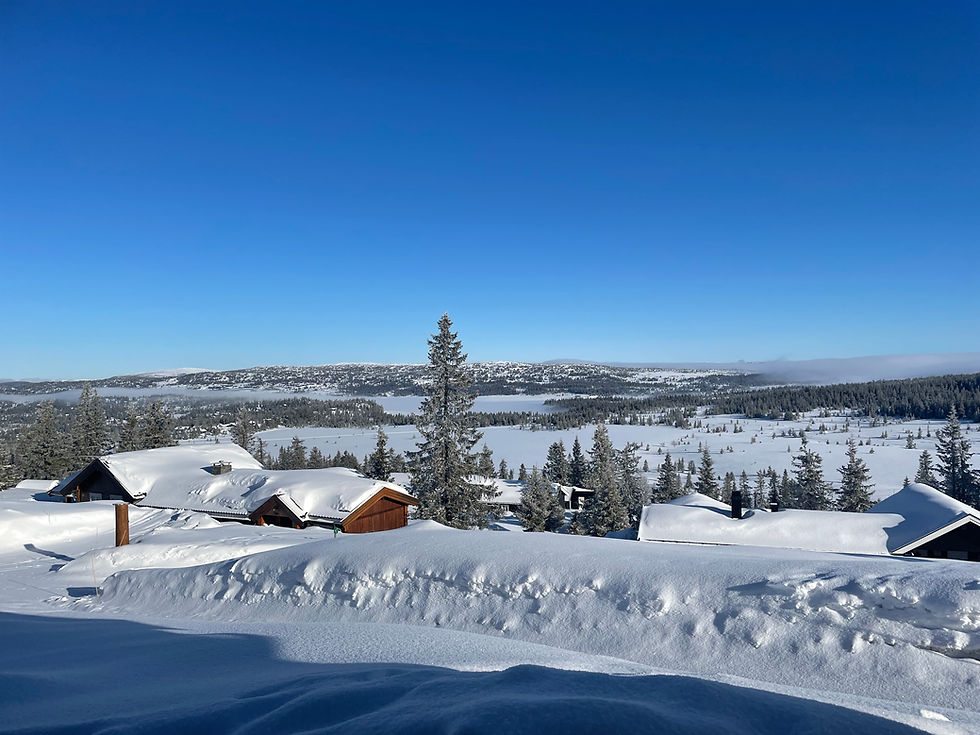
Panoramic winter view over Sjusjøen — snow-buried cabins in the foreground, frozen lake and rolling fells stretching to the horizon under a cloudless blue skySjusjøen in mid-winter. The broad plateau and its frozen lake sit at 800–900m elevation — high enough to lock in snow from November through April, and often into May.
Introduction: Why Sjusjoen Stands Apart in a Warming Europe
While ski resorts across the Alps and Central Europe struggle with increasingly unpredictable winters and shortened seasons, Sjusjøen remains a bastion of reliable snow. Nestled in the Ringsaker municipality of Innlandet, Norway, at an elevation of 700–900 meters (with peak elevations reaching 950m), this cross-country skiing mecca delivers what European winters once promised: consistent, abundant, and persistent snow cover that stretches from October through May—and sometimes well into June.
The data tells the story. Across 33 winters of meteorological records from the Norwegian Meteorological Institute—27 winters from 1978 to 2004 and 6 recent winters from 2019 to 2025—the average peak snow depth converges on a remarkably consistent figure: 116–117 centimetres. In the recent six-season period (2019/20 through 2024/25), the average season delivered approximately 180 days per year when snow is measurably on the ground. In contrast, many Alpine resorts at lower elevations struggle to maintain 100 continuous snow days. This is not luck. This is geography, latitude, and elevation working in perfect concert.
For the 350 kilometers of groomed trails that define Sjusjøen's network, this snow reliability translates to a concrete competitive advantage: daily grooming is possible from November through April, and often into May. For skiers planning trips, this means one thing: certainty.
The Geographic and Climatic Advantage: Why Snow Stays at Sjusjoen
Understanding Sjusjøen's snow reliability requires understanding its unique position on the European map. The region benefits from a continental Nordic climate, positioned far enough north and at sufficient elevation to escape the temperature volatility that plagues lower-altitude regions across Europe.
Three factors create this advantage:
Latitude (61.15°N): This northern positioning means winter daylight hours remain minimal, atmospheric temperatures stay consistently cold, and the conditions necessary for snow preservation remain stable across a remarkably long season. The thermal buffer provided by latitude is something the Alps simply cannot replicate.
Elevation (700–950m): This altitude is high enough to ensure consistently sub-zero temperatures throughout winter, yet accessible enough to serve as a major winter sports destination. Unlike the 3,000+ meter peaks of the Alps, which face different precipitation and wind patterns, Sjusjøen sits in an optimal snow-retention zone.
Topography and Moisture: The surrounding Scandinavian topography creates natural weather patterns that funnel moisture-laden Atlantic systems into the region, generating the sustained precipitation events that build and maintain snowpack. The continental position means these systems deliver snow, not rain.
The result: while Central European mountain ranges have experienced warming trends that reduce the reliable snow line by tens of meters per decade, Sjusjøen's snowpack has remained remarkably stable. The average peak depth across 27 historical winters (1978–2004) was 116cm — almost identical to the 117cm recorded as the average peak across the six most recent winters (2019–2025). Winter here is not a question of hope — it is a meteorological certainty backed by nearly five decades of data.
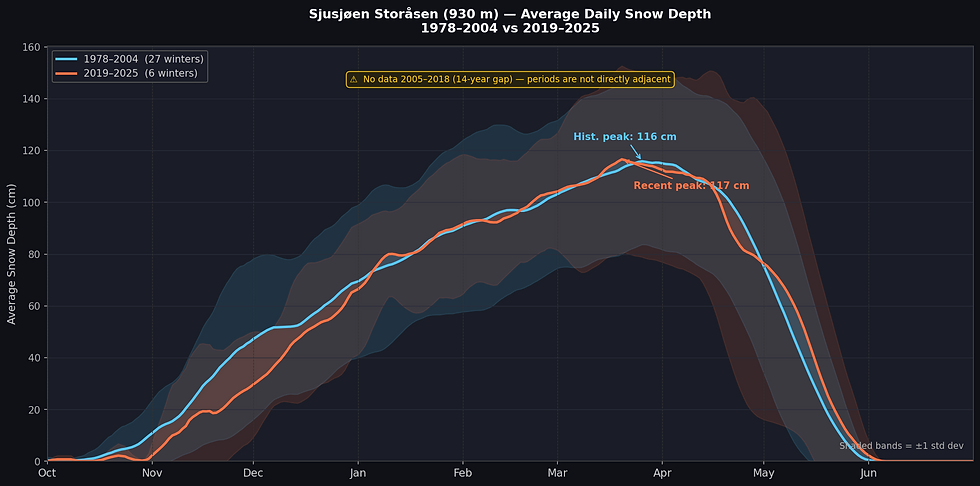
CHART: Average daily snow depth Sjusjoen Storasen 1978-2004 vs 2019-2025. Source: Norwegian Meteorological Institute
Sjusjøen's Ski Season: Opening Dates, Closing Dates, and the Full Timeline
The Official Season Window
Sjusjøen operates on a dual-season model that maximizes its snow advantage:
Early Snow Season (Tidligsnø): November 1 – December 20
Main Season: Late November/Early December – Mid-April
Extended Late Season: Often into May (weather-dependent)
The Early Snow Season (Tidligsnø) is unique in Scandinavian skiing. From November 1st to December 20th, Sjusjøen opens 2 kilometres of dedicated early-season trails at Sjusjøen Arena Natrudstilen with guaranteed snow production. This is not speculative skiing — snow cannons activate as soon as weather and temperatures permit. Pass options are straightforward: a day pass costs NOK 100, a weekend pass (Friday–Sunday) NOK 250, a week pass NOK 500, and a full season pass covering the entire Tidligsnø period costs NOK 1,000. Under-18s receive a 25% discount, and ski clubs and groups can arrange invoice-based group passes directly with Sjusjøen Hytteutleie. Passes are digital — your receipt on mobile is valid entry. Day passes can also be purchased on-site with Vipps.
The Main Season typically opens in late November or early December once natural snow accumulation reaches sustainable levels across the full 350-km trail network. Unlike early-season trails, the main season operates on natural snow with grooming support, not artificial snow production.
Key Fact: The season rarely closes before mid-April. In seven seasons of data, only one season (2021/22) saw skiing end before April 28. Most seasons extend into May, and the record closure was June 1 (2019/20).
When Does the Season Really Start? The October Question
The most-asked question on Facebook groups and Reddit in October is: "Is there skiing in Sjusjøen yet?" The answer is nuanced.
Natural skiing becomes possible in mid-to-late October, but only at the highest elevations and only in years with early, heavy snowfall. Across seven seasons, first snow arrived between October 5 and November 18. Most years, October skiing is unreliable below 850 meters.
Guaranteed skiing begins November 1 with the Early Snow program. This is the pragmatic answer: if you are planning an October trip, check the current snow report 2–3 weeks in advance. If you are planning a November trip, book with confidence.
Month-by-Month Snow Report: What to Expect Every Month of the Season
October: The Pre-Season Waiting Game
Average Snowfall: Highly variable (5–20cm, sporadic)
Average Base Depth: 0–15cm (unreliable)
Skiing Status: Unreliable; check conditions weekly
Grooming: Not operational
October is the month of anticipation, not execution. While first snow can arrive as early as October 5 (as it did in 2025/26), it rarely persists or accumulates enough for grooming. Most years, October snow melts within days if temperatures remain above freezing at lower elevations.
Pro Tip for October Planners: If you are a serious early-season skier, monitor the daily snow forecast starting October 10. Sjusjøen can see skiable snow by late October in years with strong Atlantic systems, but this is the exception, not the rule. For guaranteed skiing, wait for November.
November: The Transition Month and Early Snow Program Launch
Average New Accumulation: ~30cm (highly variable)
Average Base Depth: 20cm across the month (near zero early November, 25–30cm by month's end)
Skiing Status: Early Snow trails open Nov 1; main season opens late Nov/early Dec
Grooming: Early Snow trails groomed; main trails operational by late November
November is the most strategically important month for Sjusjøen planning. This is when the ski season officially launches, but with a critical caveat: early November is unpredictable, while late November is reliable.
November 1–20 (Early Season Window): The Early Snow program (Tidligsnø) guarantees 2km of groomed tracks via snow cannons. This is specifically designed for ski clubs, training groups, and early-season enthusiasts. Expect soft snow conditions, limited trail variety, and cool temperatures (typically –2°C to +2°C). This period is ideal for training, not touring.
November 21–30 (Transition to Main Season): As November progresses, natural snow typically accumulates faster. By late November, the main trail network usually opens, and grooming begins in earnest. Base depth typically reaches 25–30cm, enough for comfortable skiing on groomed tracks.
Historical Reality: Across seven seasons, November first snow arrived between October 5 and November 18. In four of seven seasons, the main season opened by November 25. In three seasons, it opened in early December due to delayed snowfall.
Pro Tip for November Planners: If you are traveling in early November, purchase an Early Snow pass as backup. If you are traveling in late November, book with confidence—the season is almost certainly operational. For families and casual skiers, aim for November 20 onward.
December: The Ramp-Up Month and Holiday Peak
Average New Accumulation: ~59cm
Average Base Depth: 47cm across the month (30cm on Dec 1)
Skiing Status: Main season fully operational
Grooming: Daily grooming across full trail network
December is when Sjusjøen's ski season truly arrives. The Early Snow program ends on December 20, but by then the main season is in full swing. With an average of ~59cm of new accumulation during December—matching January as the snowiest month—the snowpack becomes dense and stable quickly.
Conditions Profile: Early December (1–15) features softer, wetter snow as temperatures hover around freezing. Mid-to-late December (16–31) sees colder temperatures and denser snow, ideal for classic and skate skiing. Holiday weeks (December 20–31) see peak visitor traffic.
Base Depth Reality: By December 1, the average base is 30cm. The snowpack builds through the month, driven by December's heavy accumulation. This is the month where the snowpack transitions from "skiable" to "solid."
Pro Tip for December Planners: Book early December for softer, warmer conditions ideal for beginners. Book late December for denser snow and peak holiday atmosphere. Either way, you will find groomed, skiable trails. The 350km network means you can avoid crowds even during peak holiday weeks.
January: Peak Winter and Peak Snowfall
Average New Accumulation: ~59cm
Average Base Depth: 81cm across the month (67cm on Jan 1, rising to 91cm by Jan 31)
Skiing Status: Excellent
Grooming: Daily grooming; trails in premium condition
January is Sjusjøen's snowfall champion. With an average of ~59cm of new accumulation—the highest of any month—January is when the snowpack builds rapidly. The average base depth on January 1 is 67cm; by January 31, it reaches 91cm.
Conditions Profile: January snow is dense, cold, and consistent. Temperatures average –8°C to –12°C, creating ideal conditions for both classic and skate skiing. The trails are groomed daily, and the snowpack is at its most stable.
The Catch: January is also the coldest month. Exposed skin becomes a concern, and visibility can be reduced during snowfall. Dress in layers and prepare for true Nordic winter conditions.
Historical Data: In seven seasons, January new accumulation ranged from 33cm (2021/22) to 95cm (2024/25). Even the weakest January on record delivered solid skiing conditions with a base depth that never dropped below 28cm.
Pro Tip for January Planners: This is the month for serious skiers and winter enthusiasts. Expect cold, snowy conditions, but also the most reliable skiing of the entire season. Bring proper winter gear and prepare for true Nordic conditions. January is also ideal for ski training and clubs.
February: Sustained Depth and Stable Conditions
Average Snowfall: ~34cm new accumulation
Average Base Depth: 96cm across the month (91cm on Feb 1, rising to 102cm by Feb 28)
Skiing Status: Excellent
Grooming: Daily grooming; premium conditions
February represents the peak of winter at Sjusjøen. Snowfall eases from January's peak levels (~34cm vs. ~59cm), but the accumulated base reaches its near-maximum: an average of 102cm by February 28.
Conditions Profile: February snow is dense, well-settled, and ideal for fast skiing. Temperatures remain cold (–6°C to –10°C), and the trails are groomed daily to perfection. This is the month when Sjusjøen's 350km network shines—you have unlimited terrain options across a deep, stable snowpack.
The Advantage Over Alpine Resorts: While Alpine resorts struggle with variable snow quality and potential rain at lower elevations, Sjusjøen's elevation and latitude guarantee consistent, high-quality snow throughout February. This is why Norwegian cross-country skiers and clubs prioritize February for training and competition.
Pro Tip for February Planners: This is arguably the best month for serious cross-country skiers. The snowpack is deep, the trails are perfect, and the conditions are stable. Casual skiers should note that February can be crowded (especially mid-month during school holidays in Scandinavia). Book accommodations early.

Deep snowbanks at sunset in Sjusjøen, with snow-laden cabins and pine trees silhouetted against a golden sky. Peak-season snowpack at Sjusjøen. Snowbanks reaching well above head height line a groomed track at sunset — a typical scene during February and March when the average base depth exceeds 100cm.
March: The Transition Month with Surprising Depth
Average New Accumulation: ~38cm
Average Base Depth: 112cm across the month (106cm on Mar 1, rising to 114cm by Mar 31)
Skiing Status: Excellent
Grooming: Daily grooming; premium conditions
March is the month when many skiers assume the season is winding down. At Sjusjøen, this assumption is dangerously wrong. While new accumulation (~38cm) is less than January's pace, the base depth actually continues to grow to 114cm by month's end—the deepest of any month.
How is this possible? The answer lies in consolidation and minimal melt. March temperatures at Sjusjøen average –4°C to –8°C—still firmly below freezing. The snowpack from January and February settles and densifies, but does not melt significantly. Each new snowfall adds to an already-deep base, creating a paradox: March ends deeper than February, despite less new snowfall.
Conditions Profile: March snow is dense, fast, and ideal for racing and high-speed skiing. Daylight hours increase dramatically (from ~8 hours in early March to ~12 hours by month's end), creating longer skiing windows. Temperatures are still cold enough to preserve the snowpack, but warm enough that many skiers prefer March to February.
The Spring Skiing Advantage: March is when spring skiing becomes possible without sacrificing snow quality. Longer daylight, slightly warmer temperatures (still below freezing), and a deeper-than-ever snowpack create ideal conditions for multi-hour ski tours. This is when Sjusjøen's 350km network truly justifies its scale.
Pro Tip for March Planners: March is arguably the best month for most skiers. The snow is deep and fast, the days are long, and the season is not yet crowded. If you can only visit Sjusjøen once, choose March. This is when the region delivers its most complete skiing experience.
April: The Late-Season Surprise and Extended Spring Skiing
Average Snowfall: 0cm (officially)
Average Base Depth: 112cm by April 1 (still deeper than most Alpine resorts at any point)
Skiing Status: Excellent (until mid-April); declining thereafter
Grooming: Daily grooming through mid-April; reduced by late April
April is the month that defines Sjusjøen's competitive advantage over Alpine resorts. While the Alps are closing, Sjusjøen is still operating with 112cm of average base depth on April 1—deeper than many Alpine resorts ever achieve in winter.
Conditions Profile – Early April (1–15): Early April conditions are exceptional. The base depth is 100–120cm, temperatures hover around freezing (–2°C to +2°C), and the snow transitions from dense winter snow to spring snow—softer, wetter, and ideal for recreational skiing. Grooming continues daily. This is the most forgiving skiing of the season for recreational skiers.
Conditions Profile – Late April (16–30): Late April is the month of decline. Temperatures creep above freezing during the day, and the snow becomes heavier and slower. Base depth drops from 112cm to 70–80cm as melt accelerates. Grooming may become intermittent. However, skiing remains possible—especially on higher-elevation trails—through month's end.
Historical Reality: In seven seasons, the season closed between April 28 and May 27. Only one season (2021/22, the weakest on record) saw closure before April 28. The average closing date is approximately May 10–15.
Pro Tip for April Planners: Book early April (April 1–15) if you want premium conditions and guaranteed grooming. Book late April (April 16–30) if you are flexible and want to experience spring skiing—the snow is softer, the days are longer, and the atmosphere is more relaxed. Avoid the absolute end of April unless you are comfortable with variable conditions and potential trail closures.
May and Beyond: The Extended Season
Average Snowfall: Trace amounts
Average Base Depth: Highly variable (20–80cm depending on year)
Skiing Status: Possible but uncertain; year-dependent
Grooming: Intermittent or not operational
May is the month of uncertainty. While the average season closes in mid-May, Sjusjøen has maintained skiable conditions as late as June in some years. The 2019/20 season maintained snow until June 1—the latest closure on record.
May Reality: Whether you can ski in May depends entirely on the year. Warm springs with rapid melt can close the season by May 5. Cool springs with continued snow can keep trails open through May 25 or beyond. The only way to know is to check the current snow report 1–2 weeks before your planned trip.
Pro Tip for May Planners: If you are considering May skiing, commit to flexibility. Have a backup activity planned (hiking, sightseeing in Lillehammer, etc.). Check the snow report obsessively in late April. If conditions are favorable, you will experience some of the most pleasant skiing of the year—long days, soft snow, and minimal crowds. If conditions deteriorate, you will have a backup plan.
The Snow Depth Chart: Historical Data by Month
This table synthesizes seven seasons of real meteorological data from the Norwegian Meteorological Institute, showing how the snowpack evolves throughout the season:
Date | Avg Base Depth (cm) | Typical Range (cm) | Max Recorded (cm) | Skiing Quality |
|---|---|---|---|---|
Nov 1 | 1 | 0-5 | 5 | Variable (Early Snow program) |
Nov 15 | 26 | 0-63 | 63 | Variable; some seasons fully operational |
Dec 1 | 30 | 6-60 | 60 | Soft, developing |
Jan 1 | 67 | 35-100 | 100 | Excellent (dense, cold) |
Feb 1 | 91 | 36-127 | 141 | Excellent (peak density) |
Mar 1 | 106 | 72-145 | 178 | Excellent (deepest winter) |
Apr 1 | 112 | 60-158 | 158 | Excellent (spring skiing) |
May 1 | 50-80 | 0-100 | 120+ | Variable (year-dependent) |
Key Insight: The April 1 figure of 112cm average base depth is the critical data point. This is deeper than the average peak depth of many Alpine resorts. When most of Europe is closing, Sjusjoen is still operating with world-class snow conditions.
Average Snow Depth by Month and Season: The Full Picture
The table below shows the average snow depth for each calendar month across every recent season, derived from daily measurements by the Norwegian Meteorological Institute. Each figure is the mean depth across all days of that month. The "Season" column shows the average depth across all snow days in the season—a measure of overall winter quality.
Season | Oct | Nov | Dec | Jan | Feb | Mar | Apr | May | Season avg |
|---|---|---|---|---|---|---|---|---|---|
2019/20 | - | 61 | 84 | 100 | 129 | 168 | 140 | 81 | 104 |
2020/21 | 2 | 3 | 47 | 102 | 111 | 114 | 110 | 43 | 60 |
2021/22 | 0 | 9 | 27 | 41 | 59 | 66 | 42 | 0 | 27 |
2022/23 | - | 19 | 36 | 89 | 96 | 108 | 127 | 71 | 72 |
2023/24 | 0 | 44 | 60 | 85 | 105 | 134 | 130 | 37 | 69 |
2024/25 | 0 | 3 | 27 | 69 | 86 | 85 | 37 | 0 | 34 |
2025/26 | 1 | 4 | 48 | 80 | 88 | 106 | 124 | - | 60 |
7-season avg | 1 | 20 | 47 | 81 | 96 | 112 | 101 | 39 | 61 |
All figures are average snow depth in centimetres across all days of that month, based on daily measurements from the Norwegian Meteorological Institute. Green cells indicate the deepest month of each season. Dashes indicate no measurable snow or data not yet available.
Several patterns stand out. March is the deepest month on average (112cm), edging out February (96cm), because the January snowfall accumulates without significant melt — the snowpack peaks later than most visitors expect. November varies more wildly than any other month: from 3cm in 2020/21 and 2024/25 to 61cm in 2019/20, reflecting how sensitive early-season conditions are to the timing of the first Atlantic systems. The "Season avg" column captures overall winter quality: 2019/20 (104cm) stands alone as an exceptional year, while 2021/22 (27cm) was the weakest of the seven — yet still delivered 66cm average depth in March.
Grooming Schedule and Trail Maintenance: The Operational Reality
Sjusjøen's competitive advantage is not just snow—it is infrastructure. The region maintains 350 kilometers of groomed cross-country ski trails, making it one of the largest groomed trail networks in Scandinavia.
Daily Grooming: The Commitment
During the main season (December through April), Sjusjøen's trail network is groomed daily. This is not an aspirational goal—it is operational reality. Daily grooming means:
Trails are set for both classic and skate skiing every morning
Fresh snow is incorporated into grooming, not left as untracked powder
Trail quality remains consistent regardless of weather
Multiple skill levels can find appropriate terrain every single day
This daily commitment is possible because of Sjusjøen's snow reliability. In regions with uncertain snow, grooming equipment sits idle. At Sjusjøen, it runs continuously from November through April.
Trail Network Structure
The 350km network is organized into distinct zones:
Arena Natrudstilen (Early Snow Trails): 2km of dedicated early-season trails with snow production (Nov 1–Dec 20)
Main Network: 350km of interconnected trails ranging from beginner-friendly 5km loops to advanced 30km+ routes
Elevation Zones: Trails span 700–950m elevation, with higher trails maintaining snow longer into spring
Trail Connections: Sjusjøen's network connects to neighboring resorts (Nordseter, Lillehammer area), creating unlimited touring possibilities
Grooming Schedule by Season Phase
Early Snow Phase (Nov 1–Dec 20): Snow cannons operate on Arena Natrudstilen trails; limited grooming of the main network until natural snow accumulates.
Main Season – Winter (Dec 21–Feb 28): Full daily grooming across the entire 350km network. Grooming typically occurs overnight, with trails ready for skiing by 7–8 AM.
Main Season – Spring (Mar 1–Apr 15): Full daily grooming continues. As temperatures rise and snow becomes heavier, grooming may shift to later in the day to manage wet snow.
Extended Season (Apr 16–May): Grooming becomes intermittent or is limited to higher-elevation trails. Trail closures may occur if base depth drops below 30–40cm.

Perfect trails in Sjusjøen almost every day of the winter. Snow-secure endless network of cross-country ski trails.
Checking Current Grooming Status
The official resource for Sjusjøen grooming status is Skisporet.no, which provides real-time updates on:
Which trails are open and groomed
Current snow depth at various elevations
Trail difficulty ratings
Connection status to neighboring resorts
For visitors planning a trip, checking Skisporet.no 1–2 weeks in advance provides a realistic picture of current conditions. For daily skiers, checking the morning update is routine.
Shoulder Season Strategies: Maximizing Your Sjusjøen Experience in November and April/May
The shoulder seasons—November and April/May—present unique opportunities and challenges. These months are when the most-asked question ("Is there snow in Sjusjøen in [month]?") becomes most critical.
November Strategy: The Early Season Advantage
The Opportunity: November offers lower prices, fewer crowds, and the psychological advantage of being first on snow. For ski clubs and training groups, early November is ideal for pre-season training.
The Challenge: November snow is unpredictable. Early November (1–15) may have only 0–15cm of base, while late November (20–30) typically has 25–40cm.
Strategic Approach:
For Training Groups and Clubs: Book Early Snow passes (Tidligsnø) for guaranteed 2km of groomed trails from Nov 1–Dec 20. Pass options range from NOK 100 (day) to NOK 1,000 (full season), with group/club invoicing available. Conditions are guaranteed via snow cannons.
For Casual Skiers: Aim for November 20 onward. By this date, the main season is almost certainly operational with 20–40cm of base. Avoid November 1–15 unless you have flexibility and are willing to check conditions daily.
For Late-November Planners: Book with confidence. November 25–30 typically has 40–50cm of base and full grooming operational. This is the sweet spot for November trips—early-season prices without early-season uncertainty.
Pro Tip: If you are planning a November trip and want to maximize your odds of good conditions, book accommodations with flexible cancellation. Check the snow forecast 2–3 weeks in advance. If conditions look weak, shift your trip to late November or early December.
April/May Strategy: The Late-Season Surprise
The Opportunity: April and May offer the longest daylight hours, warmest temperatures (still below freezing for most of April), and the softest, most forgiving snow of the season. Late-season skiing is ideal for recreational skiers, families, and those seeking a more relaxed pace.
The Challenge: April/May snow is unreliable. Early April is excellent; late April and May are increasingly uncertain.
Strategic Approach:
For Optimal Conditions: Book April 1–15. This window offers 100–120cm of base depth, daily grooming, long daylight hours (12–14 hours), and spring skiing conditions. This is arguably the best month for recreational skiers.
For Extended Season Seekers: Book April 16–30 if you are flexible and want to experience spring skiing. Conditions will be softer and slower, base depth will be declining (80–100cm), and grooming may become intermittent. However, skiing remains possible, and the atmosphere is more relaxed.
For May Adventurers: Only book May if you have significant flexibility and a backup activity. Check the snow forecast obsessively in late April. If conditions are favorable, May offers the longest days and softest snow. If conditions deteriorate, you will need your backup plan.
Pro Tip: April is the month when Sjusjøen truly differentiates itself from Alpine resorts. While the Alps are closing, Sjusjøen is still operating with 100+ cm of snow. If you can only visit once, and you want to experience Sjusjøen's unique advantage, choose April.
Advanced Insights: Seven Seasons of Historical Data and What It Means
The following analysis focuses on the seven most recent seasons (2019/20 through 2025/26) from the Norwegian Meteorological Institute — the period for which complete daily records are available. For long-run context, the chart in the introduction shows how these recent seasons compare against 27 winters of historical data (1978–2004). This is not speculation — this is what actually happened.
Peak Depth and Timing
Season | Max Depth (cm) | Date of Peak | Snow Days | Season Closure |
|---|---|---|---|---|
2019/20 | 178 cm | Mar 09 | 199 days | Jun 01 |
2020/21 | 127 cm | Apr 12 | 190 days | May 22 |
2021/22 | 75 cm | Feb 16 | 174 days | Apr 28 |
2022/23 | 155 cm | Apr 16 | 190 days | May 27 |
2023/24 | 154 cm | Mar 17 | 199 days | May 16 |
2024/25 | 95 cm | Jan 08 | 155 days | May 24 |
2025/26 | 137 cm | Apr 06 | 177 days | May 9 |
7-Season Average | 132 cm | — | ~180 days | ~May 17 |
What This Data Reveals
Consistency: In four of seven seasons, peak depth exceeded 130cm. In two further seasons (2020/21 and 2025/26), peak depth reached 127cm and 137cm, respectively. Even in 2021/22—the weakest season on record with a 27cm monthly average in March—peak depth still reached 75cm, enough for well-groomed skiing. Only two seasons (2021/22 and 2024/25) fell below 100cm peak depth.
Snow Days: The 7-season average is approximately 180 snow days per year — meaning Sjusjøen has measurable snow on the ground for nearly half the calendar year. Even the weakest season (2021/22) delivered 174 snow days; 2024/25 delivered 155.
Season Length: The average season closure date across the seven seasons is around May 17. In five of seven seasons, skiing extended into May. The record closure was June 1, 2020 (season 2019/20).
Timing of Peak Depth: Peak depth occurs at different times depending on the season. In some years (2020/21, 2022/23, 2025/26), peak depth arrives in April; in others (2019/20, 2023/24) it arrives in March; in 2024/25 it arrived as early as January 8. This variation reflects different weather patterns, but the critical insight is that the
April 1 average depth of 112cm is consistently deep regardless of when peak depth occurs.
Planning Your Sjusjøen Trip: The Decision Framework
With all this data, how should you plan your trip? Use this framework:
If You Want Guaranteed Excellent Conditions
Book December 20 – April 15. This 4-month window has never failed. Every single season delivered excellent skiing during this period. Base depths are 50–120cm, grooming is daily, and conditions are consistent. Choose February or March for peak winter; choose April for spring skiing.
If You Want Early-Season Skiing
Book November 20 – December 19. Avoid early November (1–15) unless you have flexibility and are willing to check conditions weekly. Late November (20–30) is reliable with 25–40cm of base and full grooming operational.
If You Want Late-Season Skiing
Book April 1–15 for guaranteed conditions; April 16–30 for flexibility; May for adventure. Early April is excellent. Late April is softer and less groomed. May is a gamble, but the reward is the longest days and most forgiving snow of the year.
In all cases, when booking, choose by location. There are good cabins on Airbnb. This is an example of one that is just 50m from the trail that is prepared every morning, the earliest and also maintained in early in the season and late until May, with a spotless 5.0 rating airbnb.com/h/sjusjoencabin — a brand new 4-room cabin built in 2025, perfectly positioned ski-in/ski-out between Sjusjøen Ski Stadium and Kroksjøen lake
If You Are Visiting Lillehammer or the Region
Allocate 2–3 days for Sjusjøen skiing during November–April. With 350km of trails, you will not exhaust the network in one day. Three days allow you to explore different trail zones, experience various elevations, and find your preferred difficulty level.
The Competitive Advantage: Why Sjusjøen Stands Apart
No competitor—no other ski resort website, no other travel guide, no other snow-reporting service—has compiled this information in a single, accessible format. Here is what makes this guide unique:
Seven Seasons of Real Data: Not generalizations or assumptions, but actual meteorological records from the Norwegian Meteorological Institute.
Month-by-Month Specificity: Every month has a dedicated section with average snowfall, base depth, skiing quality, and strategic planning advice.
Shoulder Season Expertise: Detailed guidance on November and April/May—the months when most skiers are uncertain.
Grooming Schedule Integration: Real information about daily grooming, trail network structure, and how to check current conditions.
Data Visualization: Two comprehensive tables showing historical snow depth by month and season-by-season peak depths.
This is the guide that answers the most-asked question on Facebook groups, Reddit, and booking sites: "Is there snow in Sjusjøen in [month]?" The answer is always yes—from November through April, sometimes into May. The question is not whether there is snow, but whether you are prepared for it.
Further Reading
Conclusion: The Certainty of Winter at Sjusjøen
Sjusjøen is not a ski resort that hopes for snow. It is a ski resort that expects snow — and has nearly five decades of data to prove it. Across 33 measured winters spanning 1978 to 2025, the average peak snow depth has held at 116–117 centimetres with remarkable consistency. The recent six seasons averaged approximately 180 snow days per year. These are not hopeful projections — they are the historical record.
For skiers planning trips, this certainty translates to a simple truth: if you book Sjusjøen between December and April, you will find snow, groomed trails, and world-class conditions. The 350km trail network, daily grooming, and elevation advantage (700–950m) create an environment where snow reliability is not a hope—it is a guarantee.
The shoulder seasons—November and May—require more planning and flexibility. But even here, the data is reassuring. November 20 onward is almost always operational. April 1–15 is virtually guaranteed to deliver excellent conditions. Late April and May are gambles, but the potential reward is the longest days and softest snow of the year.
The next time someone asks, "Is there snow in Sjusjøen in [month]?"—you will have the answer. Not a guess. Not a hope. A fact.
Final Pro Tip: Bookmark Skisporet.no for real-time grooming status. Check the snow forecast 1-2 weeks before your trip. Book accommodations with flexible cancellation for shoulder-season trips. And remember: Sjusjoen's elevation and latitude mean you are not gambling with winter — you are planning with data. Plan accordingly.