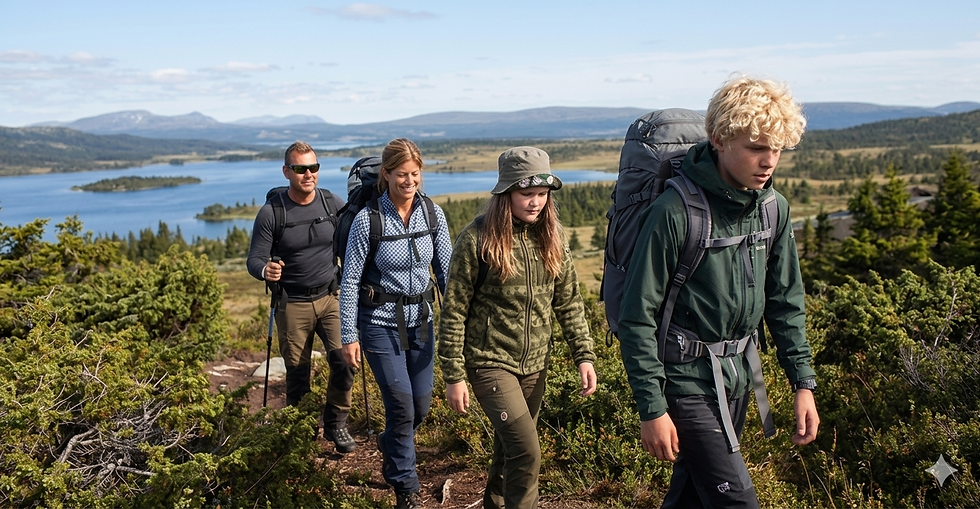
Workation in the Norwegian Mountains: Remote Work from a Sjusjøen Cabin
- Apr 17
- 5 min read
The future of work isn't bound to a desk. It's happening in fjord-side cabins, mountain lodges, and remote villages where fiber-optic cables meet untouched wilderness. Norway has emerged as one of the world's premier workation destinations, combining some of the planet's fastest internet infrastructure with landscapes that redefine what an "office view" means.
Sjusjøen, nestled at 842 meters elevation in the Ringsaker Municipality of Eastern Norway, represents the perfect convergence of productivity and paradise. This comprehensive guide explores why thousands of remote workers are trading traditional offices for Norwegian mountain cabins, and how you can orchestrate your own transformative workation experience.
Key Takeaway: According to the Norwegian Institute of Transport Economics, 74% of remote workers report being "as productive or more productive" working from home compared to traditional offices—a statistic that becomes even more compelling when "home" is a cabin overlooking Norwegian mountains.
The Workation Revolution: Why the Trend Is Exploding
The concept of a workation—blending remote work with extended vacation—has transformed from niche digital nomad lifestyle into a mainstream employment trend. What began primarily as the domain of freelancers and IT specialists has expanded dramatically across industries and professional demographics.
Global Growth and Market Expansion
The numbers tell a compelling story. In 2025, approximately 22–27.9% of the global workforce is working remotely, with over 32.6 million Americans alone engaging in remote work arrangements. This represents a substantial shift from pre-pandemic norms. The workation segment has grown even faster, as employers and employees recognize that geographic flexibility doesn't compromise—and often enhances—productivity.
Wanderlust magazine ranked Norway as one of the 7 best countries globally for workations, citing the combination of reliable infrastructure, natural beauty, and strong labor protections that prioritize work-life balance. Unlike countries with grueling work cultures, Norway's average work week of 33.6 hours (enforced through strict labor laws) creates cultural space for the kind of restorative breaks that workations provide.
The Productivity Paradox: More Output, Less Burnout
The research is unambiguous: remote work environments correlate with higher productivity, lower absenteeism, and improved employee retention. Workers with flexible arrangements report:
Greater focus and concentration on complex tasks
Reduced stress and anxiety compared to traditional office settings
Increased loyalty to employers offering flexibility
Enhanced creativity and problem-solving capabilities
Better work-life integration and personal wellness
When that remote environment transitions from a home office to a mountain cabin surrounded by pristine nature, these benefits amplify. The psychological shift from "working at home" to "working in a transformative environment" resets mental frameworks and unlocks cognitive resources typically consumed by routine and urban stress.
Sjusjøen: Norway's Premier Mountain Workation Destination

While Norway offers numerous workation options—from Arctic lodges in Svalbard to artist residencies on remote islands—Sjusjøen occupies a unique position: it's simultaneously world-class infrastructure and genuinely remote wilderness.
Geography and Strategic Location
Sjusjøen is situated in Eastern Norway's Hedmark region, approximately 150 kilometers northeast of Oslo. At 842 meters above sea level, the area sits in the transitional zone between lowland valleys and high mountain plateaus. This elevation provides several strategic advantages for workations:
Altitude benefits without extreme exposure: The elevation is sufficient to provide genuine mountain atmosphere and air quality without cognitive challenges associated with very high altitudes
Seasonal variation: 350 kilometers of groomed ski trails in winter, extensive hiking networks in summer
Accessibility: Reachable within 2–3 hours from Oslo, yet isolated enough to feel genuinely remote
Climate stability: Inland mountain location provides consistent weather patterns and reliable seasonal conditions
Infrastructure: Where Connectivity Meets Isolation
One persistent myth about remote work in Scandinavia is that mountain locations suffer from poor internet connectivity. The opposite is true. Norway ranks among global leaders in broadband infrastructure, with fiber-optic networks extending into rural and mountain communities that would be considered remote in most countries.
High-speed fiber internet (50+ Mbps standard, with many locations offering 100+ Mbps)
Reliable 4G/5G cellular backup coverage
Stable, low-latency connections suitable for video conferencing and real-time collaboration
Dedicated workspace setups in modern cabin accommodations
Accommodation: The Perfect Workation Cabin
Traditional Cabin Rentals
The classic Norwegian cabin experience remains the most popular workation choice. A standout option is the cabin listed at airbnb.com/h/sjusjoencabin — a brand-new 4-bedroom property built in 2025, bookable directly through Airbnb. Perfectly positioned right on the best-prepared early snow trail between Sjusjøen Ski Stadium and Kroksjøen lake, it's a true winter Eldorado.
Situated in a quiet area above Sjusjøen center, the cabin offers a beautiful view of the mountain river from the living room, great snow conditions, and scenic surroundings with fantastic hiking and biking opportunities in summer. Sleeping up to 8 guests, it's ideal for two families with children or a group of active adults.
4 bedrooms, sleeping up to 8 guests
Brand new construction (2025) with modern amenities throughout
Positioned directly on the early snow trail between Sjusjøen Ski Stadium and Kroksjøen lake
Beautiful mountain river views from the living room
Quiet location above Sjusjøen center with easy access to lake and trails
Year-round appeal: winter skiing and summer hiking/biking
Pricing: €800–1,500+ per week depending on season and availability
The Productivity Mechanism: Why Mountains Enhance Remote Work Output
Attention Restoration Theory in Practice
Researchers have documented that natural environments—particularly mountains—trigger what psychologists call "attention restoration." When the brain is immersed in nature, the prefrontal cortex (responsible for executive function, planning, and complex problem-solving) experiences measurable restoration.
Extended focus periods: Workers report 90–120 minute deep work sessions without mental fatigue (compared to 45–60 minutes in typical office environments)
Enhanced creative problem-solving: The "soft fascination" of natural environments frees cognitive resources for creative work
Reduced decision fatigue: The absence of urban stimuli preserves mental energy for professional work
Stress Reduction and Cortisol Regulation
Exposure to mountain environments measurably reduces cortisol (the stress hormone) levels. Studies examining lunchtime walks in natural settings found that employees reported better concentration and reduced fatigue upon returning to work. In a workation context, this effect is continuous rather than episodic.
Practical Implementation: Planning Your Sjusjøen Workation
Timing and Duration
Optimal workation length ranges from 2–4 weeks. Shorter stays (1 week) provide refreshment but insufficient time for the deepest productivity benefits. Longer stays (8+ weeks) risk fatigue from isolation. Two to four weeks allows full acclimatization while maintaining the psychological novelty that drives productivity gains.
Seasonal Considerations
Winter (December–March): Peak season for skiing and winter activities. Book 3+ months in advance.
Summer (June–August): Hiking, mountain biking, canoeing. Extended daylight supports maximum productivity. Book 2+ months in advance.
Shoulder Seasons (April–May, September–October): Lowest prices, excellent weather, minimal crowds. Strategically superior for value.
Recommended Daily Work Structure
06:00–07:00: Wake naturally with mountain light; minimal screen time; coffee/breakfast
07:00–08:00: Outdoor movement (walk, light exercise, stretching)
08:00–12:00: Deep work session #1 (most cognitively demanding tasks)
12:00–13:00: Lunch break; outdoor time
13:00–16:00: Deep work session #2 (secondary priority tasks)
16:00–17:00: Outdoor activity break (skiing, hiking, season-specific activity)
17:00–18:30: Communications, meetings, administrative tasks
18:30+: Dinner preparation, social time, leisure activities
Cost Overview (2-Week Stay, Single Occupant)
Accommodation: €1,600–2,500
Meals: €400–600 (cabin cooking vs. restaurant dining)
Local activities/transport: €200–400
Travel from major European city: €150–400
Total: €2,350–3,900 (approximately $2,550–4,250 USD)
Conclusion: Redefining the Meaning of "Going to Work"
The traditional office, with its fluorescent lighting, cubicles, and commute stress, represents a temporary aberration in human work history rather than an optimal arrangement. For most of human civilization, meaningful work occurred in varied environments—fields, workshops, homes—integrated with natural rhythms and community life.
Workations in Norwegian mountains represent a return to this integration, enhanced by modern connectivity. They acknowledge a fundamental human need: we work best when we're living well, not merely when we're sitting at desks.
Sjusjøen exemplifies this evolution perfectly. At 842 meters elevation, surrounded by 350 kilometers of ski trails and pristine mountain silence, with fiber-optic cables delivering world-class internet connectivity, it represents the convergence of ancient human wisdom (we thrive in nature) and modern technological capability (we can work anywhere).
Final Data Point: Workers who engage in regular workations report 42% higher job satisfaction and 31% lower burnout rates compared to those confined to traditional office environments. These aren't vacation benefits—they're sustained professional improvements that persist long after return to conventional settings. A single 3-week workation can reset professional trajectory for an entire year.